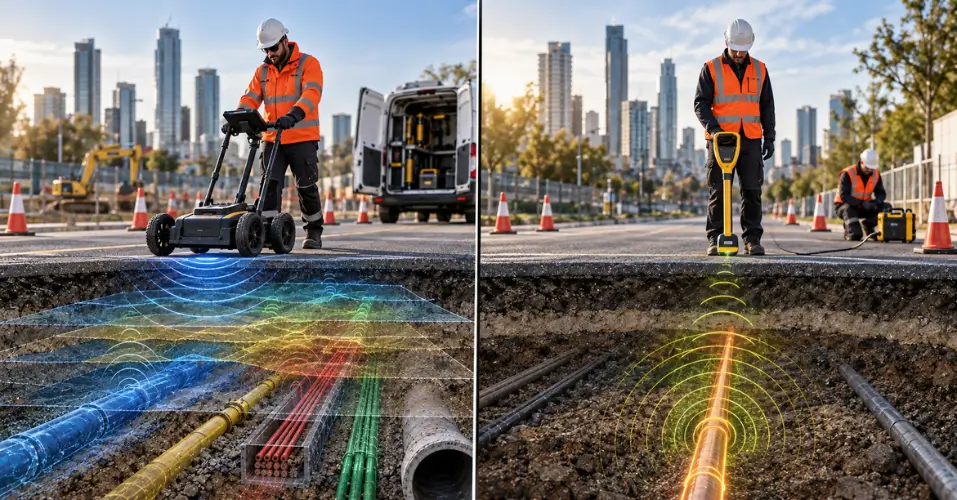
Consider you have started a construction process and suddenly, while drilling, the machine comes into contact with a water pipe or some dangerous electric cables what then? A worker might get hurt, and your project will be delayed.
Therefore, instead of facing such consequences, it is considered to set up a strong foundation for construction so that, as a project owner, your expectations will be met. For that, the experts at Apex Engineering Services utilise the capabilities of Ground Penetrating Radar (GPR) and Electromagnetic Location (EML).
But in the comparison of GPR vs EML, neither piece of equipment can solely win because both have the same purpose: to detect what is buried underground precisely. In this case, GPR identifies non-metallic elements like plastic pipes and ducts.
On the other hand, EML is all about the detection of metallic components, including cables. This blog will explicitly shed light on the difference between these two advanced tools.
What Is Ground Penetrating Radar (GPR)?
It is equipment that comes with a transmitter and receiver that are fastened together at a common offset. The performance begins when GPR utility detection sends radio waves in order to examine the underground utilities, and it also lets engineers view an accurate image of subsurface objects.
Additionally, the return time of waves will be captured by the receiver. This collected information can be used to examine the depth and geometry of a particular hidden reflector.
GPR is specifically appropriate for:
- Pipes that are not made of metal, and ducts
- Voids: It is a gap beneath the ground, and it can be either natural or man-made through building tunnels and utilities.
- A congested pathway of pipes can also be identified.
GPR is widely known for providing precise depth and even the position of utilities.
What is Electromagnetic Location?
Similar to GPR, this tool also has a transmitter and receiver to discover underground electric cables. As buried utilities send particular signals when an electric current is induced in them.
Therefore, EML is responsible for electromagnetic induction into the cable with the help of the transmitter. Even though the strength of the signals can be detected, engineers can have an idea of how deep a certain object is present.
Then the receiver records the signals that are coming from a metallic cable.
EML is effective for:
- Utilities that are entirely made of metal, including copper cables and steel pipes.
- Live telecommunication and electric cables that can be identified through these locators.
- Examining areas where bundles of cables are located.
As the world is moving toward advancement so does electromagnetic utility detection features are undergone into enhancements like signals can get filtered by minimising the effect of nearby utilities, not only audio but visual image can be shown, and data can be stored so that engineers can view the information on depth and location of utilities accurately.
What Happened When Both These Equipment Combined?
The professional operators of Apex Engineering Services rely on the characteristics of both GPR and EML. Because Ground Penetrating Redar has certain limitations like it detect only non-metallic utilities and in case of rich minerals the signals get dispersed, so it can be eliminated with the support of Electromagnetic Location.
Therefore, to get the exact location of steel bars that are hidden in concrete, this coordination between both tools is necessary, so that no harm will be caused.
It doesn’t matter if you are constructing a building from scratch and renovating an already existing structure; you will get a detailed report on what is concealed under the surface.
FAQs
Is GPR better than electromagnetic locating for finding underground utilities?
Neither is outright "better." GPR detects non-metallic pipes, voids, and structures, while EML traces live or energised metallic conductors with high precision. Most professional surveys use both together.
Can electromagnetic locating detect plastic pipes?
No. EML only detects utilities that generate or carry an electromagnetic signal, so plastic, PVC, and other non-metallic pipework needs GPR instead.
Why does GPR sometimes fail to identify the exact type of utility it detects?
GPR reads reflected radar energy based on material contrast, not electrical signatures, so it can confirm something is buried without always confirming what it is; that's where EML tracing often helps.
Does ground condition affect the accuracy of these methods?
Yes. GPR loses effective depth in wet or clay-heavy soils, while EML accuracy drops in electromagnetically congested areas like substations or dense multi-utility corridors.
Is GPR necessary before drilling into concrete?
Yes. GPR concrete scanning is considered essential before coring or drilling, since it reveals rebar, post-tension cables, and embedded conduits that EML cannot detect within a slab.
Conclusion
The construction and utility industries have had many years to perfect the art of detection and identifying potential obstacles underground. GPR and EML were never intended to battle each other, but rather, to tackle different, unique problems.
GPR is for identifying objects that reflect a signal transmitted from the ground surface back to the receiver, regardless of the material the object is made of or what depth it is at. EML is for detecting live or energised conductors by analysing induced and radiated signals produced by the object, regardless of the material it is made of.
So, Apex Engineering Services has combined the powers of both to avoid injuries and costly project delays. Reach out to their team if you need engineers and want to streamline your construction process.