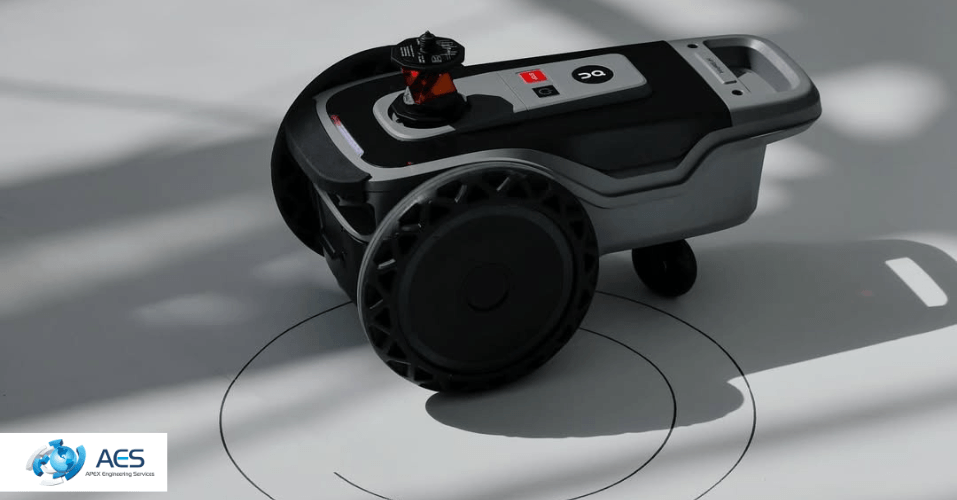
HP SitePrint is an advanced robot that Apex Engineering Services widely uses to print CAD files and layouts onto the floor. This implies precision in every single measurement, minimisation of manual work, and prevention of delay in the project timeline.
However, negligence in the utilisation of this gadget means the occurrence of human errors because of intricate coordination, intense time pressure, and inattention. This might cost more in the end.
So, through this blog, you will be learning the necessity of integrating the HP SitePrint construction layout robot to drive clarity in architectural proposals.
Why HP SitePrint Is Considered Vital For Bringing Accuracy In Architectural Proposal
Before the arrival of HP SitePrint’s automated construction layout, architects had to face certain challenges on their own:
They draw every single LINE with their bare hands, and measurements are based on assumptions.
Previously, there was no possibility of undoing mistakes, but they had to erase it all and re-ink again.
Prior to the 1980s, there was no CAD software. The overall building structure was created with the help of T-squares, compasses, set squares, and French curves according to the requirements of the client. However, still with CAD, architects manually shift design onto construction by using chalk and tape to draw lines on uneven and concrete slabs. This might result in costly mistakes.
In simpler terms, the overall accuracy is completely dependent upon the expertise of the architect. That is where a gap builds between a design and an end-constructed building, and only a robot can bridge it.
HP SitePrint: Streamlining The Complexities That Emerged In Construction
This efficient technology has given leverage to architects and builders by eliminating the barrier of miscommunication with contractors, since the entire team will be on the same page.
Therefore, with the coordination of the Robotic Total Station (RTS), HP SitePrint precisely shifts the CAD digital blueprint onto the site. As the RTS tracks the robot prism in real-time to ensure high-level perfection in printing, and no obstacle creates a hindrance.
Moreover, if a robot deviates from its provided CAD file path due to a blind blockage, then RTS calculates the HP SitePrint's new location and continues printing accurately from the other side of the obstacle.
In case of a revision request, the architect does not need to begin from level 1, but the updated files can be directly sent to the cloud, and RTS will guide the robot to mark the updated layout immediately.
Major Advantages That Come With HP SitePrint:
- The necessity of three or more workers to do measurement and mark lines has been eliminated, as a single operator can monitor the activities of HP SitePrint.
- Before, manual work required days or weeks; now, this robot has increased up to 10x enhancements in printing and site productivity.
- The cost relevant to the requirement of physical labour and covering up for mistakes has been reduced.
- The construction project can be inaugurated and resolved on the desired date, because of great precision and speed.
- This robot has a self-correcting mechanism to ensure nothing goes off the design. Hence, constant positioning data that is provided by the Robotic Total Station to HP Site Print assured millimetre-level accuracy.
Did You Know?
The experts of Apex Engineering Services will also prepare a CAD file for you, which shows a 3-and 2-dimensional design. This will maximise the efficiency of HP SitePrint in laying out this detailed information perfectly on-site.
FAQS
What is HP SitePrint and how does it work?
HP SitePrint is a construction layout robot that transfers CAD drawings directly onto construction floors. It works with a Robotic Total Station (RTS) that tracks the robot in real-time, ensuring it prints layouts with millimetre-level accuracy on-site.
How much faster is HP SitePrint compared to manual layout marking?
HP SitePrint is up to 10 times faster than traditional manual methods. What previously took days or weeks with multiple workers can now be completed in hours by a single operator monitoring the robot.
What happens if there's an obstacle in the robot's path?
If HP SitePrint encounters an obstacle, the Robotic Total Station automatically recalculates the robot's position and guides it to continue printing accurately from the other side, ensuring no interruption in the layout process.
Can design changes be made after printing has started?
Yes. Updated CAD files can be sent directly to the cloud, and the RTS will immediately guide HP SitePrint to mark the revised layout without needing to restart the entire process from scratch.
Does using HP SitePrint reduce construction costs?
Yes. HP SitePrint reduces costs by minimising labour requirements (one operator vs. three or more workers), eliminating expensive rework from manual errors, and preventing project delays that lead to additional expenses.
Conclusion
From the days of hand-drawn plans and chalk lines on concrete, construction has advanced significantly. HP SitePrint is not just a technological advancement; it is a fundamental change that turns ideas into reality.
The message is clear for builders and architects: accuracy should not be left to chance. Therefore, having a construction layout robot that works nonstop with your team is not only convenient but also crucial when deadlines are approaching, and millimetres count.
At Apex Engineering Services, experts have personally witnessed how this technology turns disorganised construction sites into well-organised operations. Will the outcome be? projects completed on schedule, within budget, and precisely reflect the intended plan.
Are you prepared to do away with speculation in your upcoming project? So, reach out to AES engineers to discuss how HP SitePrint can benefit you.