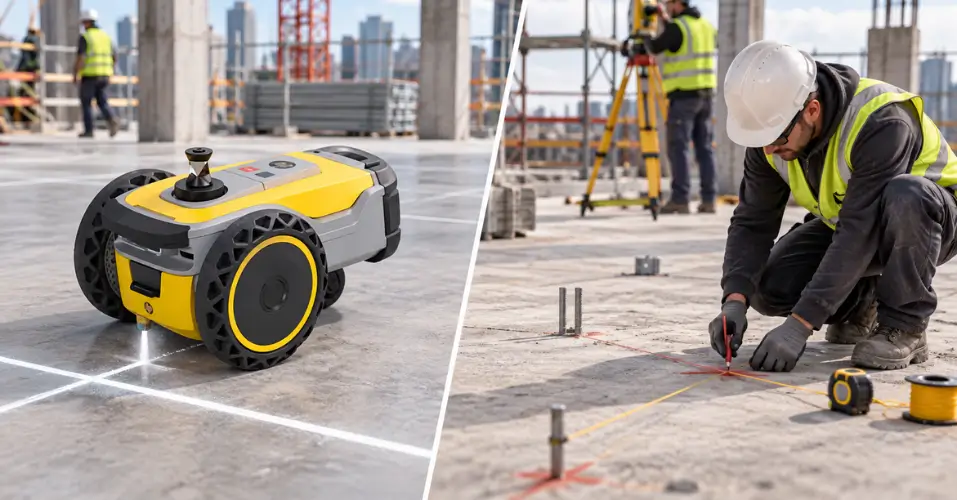
It is not wrong to say that both methods deliver accuracy in their own way during construction. But in comparison with HP SitePrint, traditional setting out relies on survey-controlled points, with the layout then transferred manually using squares, hammers, nails and tapes.
On the other hand, HP SitePrint is an advanced robot that does precise markings on the floor with the help of CAD-derived layouts. Builders can rely on this equipment, as it delivers accuracy within millimetres.
So, in this blog, you will learn whether HP SitePrint or traditional setting out is ideal for commercial and residential building projects.
What Exactly Is Traditional Setting Out?
Traditional or normal setting out is more like a manual process in which constructors initiate the project by keeping an architectural plan of the site for the knowledge of dimensions and boundaries. In practice, this means survey-controlled points, with layout transferred manually by chalk line and tape.
But the question is, “Will the project be turned out the same as the reference?”
Moreover, the utilisation of basic tools like tape, chalk, pencils, and plumb bobs is preferred for measurement without any guarantee of precision.
In order to measure curved parts and corners, contractors take advantage of wooden pegs that are carved from strong hardwoods. Strings are employed to highlight wall centrelines and boundaries.
Before the beginning of excavation, builders spray lime or powder to identify the markings on soil. In simple words, traditional construction setting out service is all about hand-operated labour, which maximises the likelihood of costly mistakes.
Enter HP SitePrint: A New Way to Think About Layout
Previously, during construction, a labourer has to extract the layout from the blueprint and manually trace it on the floor.
However, in this fast-paced world where numerous advancements are making intricate processes smooth, HP-SitePrint is eliminating the continuous need for builder involvement; instead, it starts the layout procedure as soon as the software-ready file arrives. Whereas the foundation of measurements is based on assumptions, there is a high chance that repetition might occur during work and cause delays.
Direct Floor Printing Replaces Manual Marking
HP SitePrint has surpassed the limits of imagination because it can automatically print lines on floors, whether porous or non-porous. In case of an object placement that becomes a hindrance, this robot has sensors that not only identify it but also mark accordingly.
So, robotic site layout has removed the risk of making mistakes in laying out that constructors do with the help of basic tools.
Fewer Manual Measurements
A builder has marked a line on a floor with chalk, but this is not enough, as they are required to measure it again by making sure that it is aligned with the drawing. Still, after that, there is no assurance of accuracy.
Therefore, HP SitePrint can perform such tasks in one go, as there is no need to do the same work twice. The experts at Apex Engineering Services provide CAD files to HP SitePrint for more detailed information that makes tracing efficient, whether your motive is floor planning or a complicated design that fills you with fear.
How Does AES Expertise Bring Enhancements with HP SitePrint?
The experts first recognise your requirements instead of deploying HP SitePrint directly, and then the plan will be made according to your specifications.
The second step is preparation of the robot after appropriately analysing the site. As their engineers know that every second matters in construction, rework cannot be afforded.
Now comes a part where HP SitePrint is positioned on-site to visualise how it brings accuracy in every line.
Lastly, when the robot has completed its work, the experts properly review the site to make sure that the entire process will bring the expected outcome.
So, Which One Really Wins?
Well, in terms of precision, HP SitePrint is winning the game. Mainly because the layout procedure is founded on a CAD file that is extracted through BIM modelling.
Additionally, contractors don’t need to remember every measurement and where they have marked lines in case of rain or other circumstances. This advanced robot comes with permanent and semi-permanent ink options according to the nature of the site so that lines remain intact on the surface. Most importantly, workers will be safe from on-site injuries because only a little inspection is required with HP SitePrint.
On the flip side, normal setting out can be performed manually by builders, where lines get marked on rough guesses simply to match the blueprint. How can a final structure be free from any mistake that will become a risk in the future?
Did You Know?
Apex Engineering Services is also offering setting out services, unlike traditional ones. In this method, points are set out using total station and GNSS survey control, with SitePrint's own layout tracked in real time by a robotic total station, minimising reliance on tapes and wooden pegs while maintaining the integrity of the project.
FAQS
Is HP SitePrint more accurate than manual setting out?
Yes. HP SitePrint prints directly from the CAD design file, achieving millimetre-level accuracy without the small human errors that can build up during manual measuring and marking.
How much faster is HP SitePrint compared to traditional methods?
Layouts that traditionally take a team the better part of a day can often be completed in a fraction of that time, since the robot prints the design automatically rather than requiring manual measurement and marking.
What surfaces can HP SitePrint work on?
It can print on a wide range of surfaces, including concrete, plywood, formwork, tarmac, terrazzo, and vinyl, in different colours and durability levels.