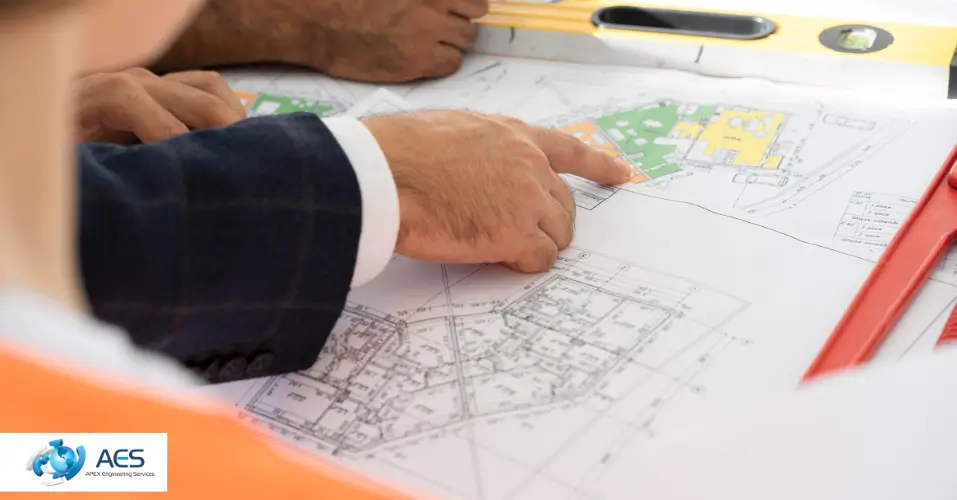
A measured building survey is the crucial aspect of renovation and redevelopment projects. However, in this survey, engineers utilise advanced equipment to collect accurate data of the building, including elevations that indicate the vertical height of specific points relative to a reference level, helping accurately define the building’s profile.
Additionally, this information will play a vital role in the development of a digital replica of the existing structure that assists in the process of construction. This blog will be explicitly highlighting the distinction between 2D and 3D measured building survey models.
2D: A Hidden Secrets of Building Are Displayed
Through this deliverable, the project owner will get square footage, floor plans, and a complete layout of the building. As there is no involvement of intricate representation of curved structures, ceiling voids, and roof structures, 2D models are easy to interpret for stakeholders.
Moreover, the major emphasis is on finding the distance between two points in a single dimension to quantify how deep and how tall something is. In simpler terms, these 2D drawings are perfect for smaller projects and are considered affordable.
3D: A Deep Insight into a Structure
From roof trusses and sloped ceilings to decorative features and irregularly shaped ones, all are being displayed virtually through a 3D measured building survey. However, 3D is about providing complete measurements of every minute curved corner in the building through the employment of efficient laser scanning technology.
Role Of Laser Scanners in The Creation of 3D Models
A laser scanner is the cornerstone of measured building survey since accuracy can never be compromised in every phase of construction. Therefore, the engineers of Apex Engineering Services initially identify the perfect position of the scanner.
Then afterward the settled laser scanner rotates and emits laser beams that hit the surfaces and return back, in this process record several million points and each point is calculated.
Furthermore, multiple scans from various locations are combined by aligning common points.
Now comes the data processing part, in which engineers remove noise and unwanted elements from the raw point cloud to give an appropriate digital representation of the building.
Lastly, the registered point clouds are imported into the software to create precise 3D models.
Mostly, these 3D drawings are applicable for the large and commercial projects, because through this, architects can test different design ideas in the context.
|
Aspect |
2D Measured Building Survey |
3D Measured Building Survey |
|
Data Collection Method |
Quick data capture using linear measurements between points |
Laser scanning captures millions of data points |
|
Time Requirement |
Faster to collect and deliver |
Requires significant time for data processing and modelling |
|
Accuracy Level |
Adequate for simple layouts; accuracy can be flexible |
Accuracy is non-negotiable and extremely high |
|
Detail Representation |
Basic floor plans and layouts |
Captures complex geometry, curves, and structural details |
|
Typical Use Case |
Small-scale and cost-sensitive projects |
Large, complex, and commercial projects |
Did You Know?
Apex Engineering Services is providing deliverables in both 2D and 3D formats to ensure that from the beginning till the end of the project everything will be simplified accurately.
What are the questions that people have for Apex Engineering Services?
What is the main difference between a 2D, and a 3D measured building survey?
The primary difference lies in accuracy and detail. A 2D survey provides basic floor plans and layouts using linear measurements, while a 3D survey captures highly accurate spatial data using laser scanning to create a complete digital model of the building.
When should I choose a 2D measured building survey?
A 2D measured building survey is ideal for smaller projects, simple renovations, or when quick and cost-effective drawings are required. It works well when complex structural details and curved elements are not critical.
Why does a 3D measured building survey take more time to deliver?
3D surveys require extensive data processing. After laser scanning captures millions of points, engineers must clean, register, and model the data to ensure non-negotiable accuracy, which naturally increases processing time.
How accurate are 3D measured building surveys compared to 2D surveys?
3D measured building surveys offer significantly higher accuracy. Every structural detail, including irregular shapes and ceiling voids, is measured precisely, making them essential for complex and large-scale developments.
Are 3D measured building surveys worth the higher cost?
Yes, especially for commercial and large projects. The high level of accuracy reduces design errors, supports better decision-making, and allows architects to test design concepts within a reliable digital model, saving time and costs later in the project.
Conclusion
The scale and accuracy requirements of the project have a major role in the decision between 2D and 3D measured building surveys. 3D surveys give a much more accurate and thorough picture of a structure, while 2D surveys are a rapid and affordable way to record important architectural dimensions. Even though 3D models take longer to process data, their unavoidable accuracy makes them essential for intricate and large-scale projects where well-informed design choices are crucial.
So, reach out if you want 2D models for a precise base for applications and 3D models for supreme exactness in regard to complex architectural elements of curved surfaces.