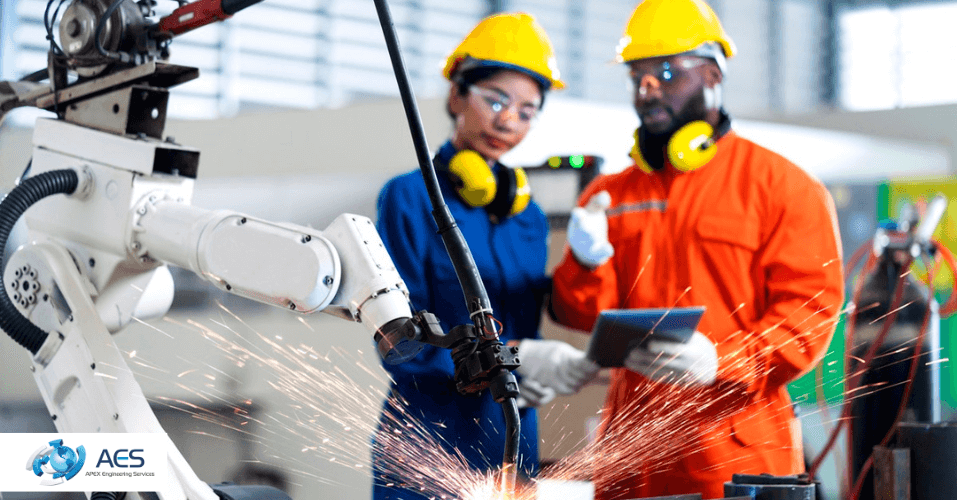
Robots are known for delivering accuracy in every phase of construction while minimising the occurrence of mistakes and accidents.
Therefore, without any doubt, it is fair to say that “robots are making the future safer.” However, this does not remove the need for a constructor on-site, since robots are unable to function on their own.
Through this blog, you will learn about the evolution that robots are bringing to the construction industry.
Through Robots, You Can Predict the Future of the Construction Industry
There are two major robotic technologies that are simplifying the intricate procedures of construction. These include:
HP SitePrint – This draws accurate lines on floors, eliminating the need for manual markings.
Robotic Total Station – This calculates angles and distances to help lay out an accurate foundation for buildings.
HP SitePrint: A Transition from Chalk Lines to Solvent-Based Inks
The benefits of robotics in construction extend well beyond traditional layout methods. Before beginning work with HP SitePrint, engineers at Apex Engineering Services prepare detailed digital layout files based on approved construction drawings.
These files are created and refined using industry-standard design and modeling software such as CAD or BIM, ensuring accuracy and alignment with project specifications.
Once finalized, the layout file is transferred to the HP SitePrint robot, which autonomously marks the design directly onto the floor. The system is capable of printing on both porous and non-porous surfaces using durable, solvent-based inks.
Prior to HP SitePrint, construction teams relied heavily on manual chalk lines, a process that was time-consuming and prone to human error. By automating the layout process, HP SitePrint significantly improves accuracy, reduces rework, and minimizes reliance on manual assumptions.
Robotic Total Station: Target Recognition with Minimum Manual Input
This is another autonomous system that works alongside HP SitePrint to manage the layout process efficiently. The Robotic Total Station measures angles and distances by emitting a laser beam and guides HP SitePrint to mark precise lines on the surface.
In simple terms, one robot assists the other in translating the CAD file directly onto the construction site. This surveying instrument is equipped with motors that allow automatic rotation and accurate aiming at a target prism.
To operate it remotely, only one surveyor is required. The need for a person to continuously stay with the tool has therefore been eliminated.
Significance of Robots in Construction
Robots reduce the need for human assumptions and opinions when setting foundations for different projects. However, this does not mean that human involvement has disappeared from construction, as machines cannot operate independently.
Most importantly, the engineers at AES understand how to use each piece of equipment correctly to ensure precision in every inch of measurement.
It has been proven that robots in construction are essential for avoiding project delays and accidents. For example, HP SitePrint is equipped with sensors that detect surrounding objects, helping to maintain safety on-site.
Frequently Asked Questions about Apex Engineering Services
Will robots replace human workers in the construction industry?
No. Robots are not replacing human workers. Instead, they assist construction professionals by improving accuracy and safety. Human expertise is still essential to operate, supervise, and interpret the data provided by tools such as HP SitePrint and Robotic Total Station.
How do robots improve accuracy in construction projects?
Robots rely on advanced technologies such as CAD/BIM software, laser scanners, GPS, and sensors to perform precise layout tasks. HP SitePrint draws exact lines on floors, while Robotic Total Station measures angles and distances, eliminating errors caused by manual assumptions.
What is HP SitePrint, and how does it help construction teams?
HP SitePrint is a robotic layout tool that automatically marks accurate lines on construction surfaces using solvent-based inks. It replaces traditional chalk lines, reduces mistakes, and works efficiently on both porous and non-porous surfaces.
Is construction with robots safer than traditional methods?
Yes. Robotic tools enhance safety by reducing manual labour, minimising human error, and detecting surrounding obstacles through built-in sensors. This helps prevent accidents and delays on construction sites.
Are robots suitable for all types of construction projects?
Robots are highly beneficial for most projects that require precise layouts and measurements. However, they must be guided and managed by skilled engineers, making them a supportive tool rather than a standalone solution.
Conclusion
Robots are revolutionising the construction sector by improving precision, safety, and efficiency in complex procedures. Although they still depend on qualified engineers for operation and interpretation, tools such as HP SitePrint and Robotic Total Station help projects stay on schedule, reduce errors, and save time.
Rather than replacing humans, robots are assisting in creating safer, more accurate, and more intelligent structures. Through the cooperation of engineers and robotic technology, a more dependable future in construction is being shaped. To experience this efficiency in your project, reach out to Apex Engineering Services.