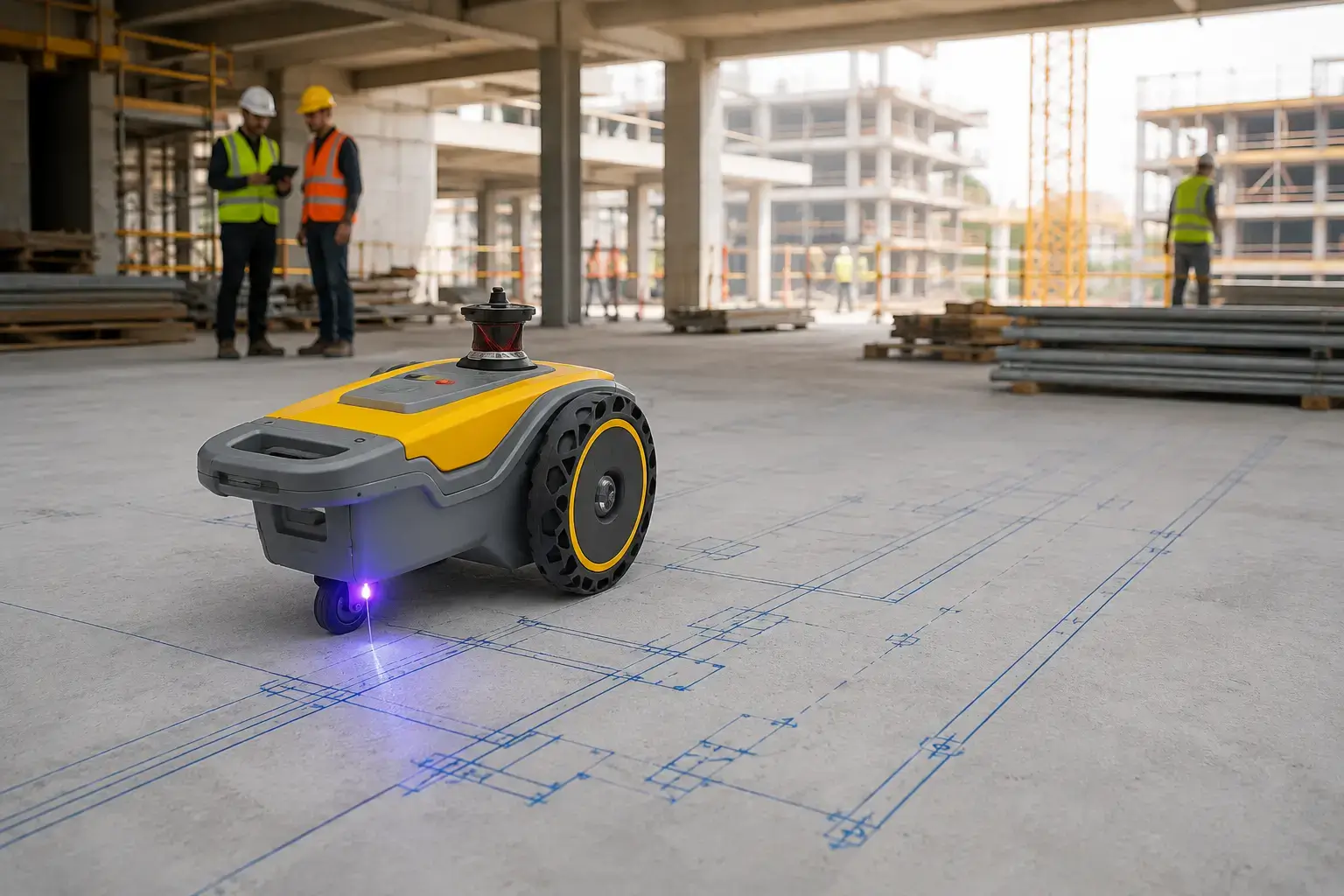
The benefits of HP SitePrint come down to one simple change: construction layouts move from the office straight onto the ground with millimetre accuracy, without the delays and errors that come with manual marking. For UK construction teams working to tight programmes, this shift in setting out technology is having a real impact on speed, accuracy, and safety on site.
This article explains what makes HP SitePrint different from traditional layout methods and sets out the main benefits it brings to modern construction projects.
What Is HP SitePrint
HP SitePrint is a compact robotic layout system that prints construction designs directly onto the ground. It reads CAD or BIM extracted files and, guided by a robotic total station, prints lines, curves, text, and symbols onto concrete, timber, tarmac, and other surfaces with millimetre level accuracy.
Rather than relying on chalk lines, tape measures, and manual marking, site teams load the design file, set control points, and let the robot complete the layout while engineers focus on coordination and quality checks elsewhere on site.
Top Benefits of HP SitePrint for Construction Projects
Faster Layout Compared to Manual Methods
Manual layout marking is one of the slowest parts of getting a site ready for the next trade. HP SitePrint can complete layouts several times faster than traditional methods, since the robot works continuously without needing rest breaks or repeated measurement checks. Work that would take a team the best part of a day can often be completed in a fraction of the time.
Improved Accuracy and Fewer Errors
Because the robotic layout is guided directly from the digital design file, HP SitePrint removes much of the human error associated with manual marking. Lines, grids, and reference points are printed to the tolerances set in the model, reducing the risk of misaligned walls, incorrect openings, or clashes discovered later in the build.
Reduced Rework and Fewer Delays
Layout mistakes are expensive to fix once trades have started work around them. By printing directly from verified CAD or BIM data, HP SitePrint reduces the number of layout related errors that lead to rework, keeping the programme on track and reducing the knock on delays that follow a single mistake.
Better Site Safety
Traditional setting out often involves bending, kneeling, or working in awkward positions to mark out lines and grids. HP SitePrint removes much of this manual handling, since the robot completes the printing while site teams supervise from a safe distance. This reduces the physical strain associated with manual layout work.
Lower Labour and Layout Costs
Manual layout typically requires two or more people working through a design methodically. HP SitePrint reduces the labour needed for this stage of the project, freeing site engineers to focus on coordination, quality assurance, and other tasks rather than repetitive manual marking.
Consistency Across Repeated Layouts
On projects with repeated units, such as housing developments or multi-storey fit outs, HP SitePrint prints the same layout with the same accuracy every time. This consistency reduces variation between plots or floors and gives trades confidence that every layout matches the design intent.
Stronger Integration with BIM Workflows
HP SitePrint works directly from CAD and BIM extracted files, keeping a clear link between the coordinated digital model and what is physically marked on site. This supports better quality assurance, since printed layouts can be checked against the model and verified with laser scanning where required.
HP SitePrint Compared to Traditional Layout Methods
Traditional setting out relies on total stations, tape measures, chalk lines, and spray paint to transfer a design from paper or screen onto the ground. This process works, but it depends heavily on the skill and concentration of the person marking out, and small errors can compound across a large slab or a complex floor plan.
HP SitePrint changes this by removing the manual transcription step entirely. The design file itself drives the robot, so the printed layout reflects the model rather than someone's interpretation of it. For site teams, this means less time spent double checking marks, fewer disputes over what a drawing actually shows, and a clearer audit trail linking the printed layout back to the approved design.
This does not replace the role of experienced setting out engineers. Instead, it changes their focus from repetitive manual marking towards reviewing accuracy, managing control points, and coordinating between trades, which is where their expertise adds the most value.
Supporting a More Predictable Programme
Construction programmes are built around a sequence of trades moving through a site in order, and layout sits right at the start of that sequence. Any delay or error at this stage tends to ripple forward, pushing back concrete pours, frame installation, or fit out work that depends on accurate marks being in place.
Because HP SitePrint completes layouts quickly and consistently, project teams can plan the following trades with more confidence. Fewer surprises at the setting out stage means fewer knock-on delays later, which is particularly valuable on programmes with limited float or multiple trades working in close sequence.
Where HP SitePrint Adds the Most Value
HP SitePrint is particularly effective on projects where layout accuracy, repetition, or programme pressure make manual marking difficult to manage, including:
- Large commercial and industrial slabs requiring column grids or service routes
- Residential developments with repeated floor plans across multiple units
- Fit out projects needing precise internal wall and service marking
- Sites with limited time windows for layout work between other trades
Frequently Asked Questions
What is HP SitePrint used for?
HP SitePrint is used to print construction layouts, such as walls, grids, and service routes, directly onto site surfaces from digital design files.
How much faster is HP SitePrint than manual layout?
It typically completes layouts several times faster than manual marking, since the robot works continuously without breaks.
Does HP SitePrint work with BIM models?
Yes, it reads CAD and BIM extracted files, keeping printed layouts closely aligned with the coordinated digital model.
Is HP SitePrint accurate enough for complex layouts?
Yes, it prints to millimetre level accuracy, making it suitable for detailed grids, curves, and service markings.
What types of projects benefit most from HP SitePrint?
Large commercial slabs, repeated residential units, and fit out projects with tight programmes see the biggest benefits.
Conclusion
The benefits of HP SitePrint go beyond speed alone. By printing directly from verified digital data, this robotic layout and setting out technology reduces errors, cuts rework, improves site safety, and keeps projects moving to programme with a level of consistency manual methods cannot match.
At AES, our HP SitePrint service brings this robotic layout technology to UK construction sites, supported by our wider construction site engineering expertise. To find out how HP SitePrint could benefit your next project, get in touch with our team.