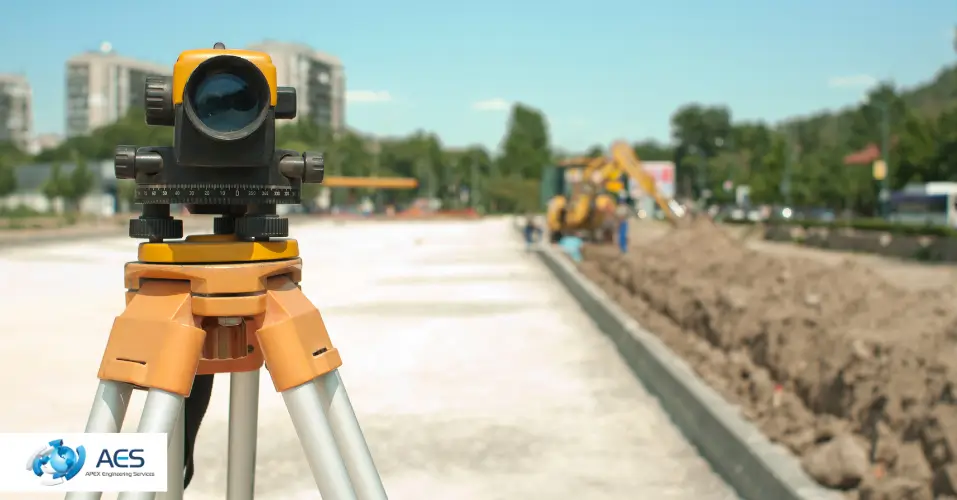
GNSS is a global navigation system, including GPS, which provides higher accuracy when multiple constellations are used. Therefore, through laser scanning, a 3D model is created to clearly analyse the landforms and building measurements. These technologies are evidently employed in topographical surveys of Apex Engineering Services.
Moreover, in utility surveys, radio detection technology and manhole lifting are usually done by mechanical and hydraulic equipment. This highlights that nowadays building a project without even knowing about the type of soil and the underlying condition of the surface is a big mistake.
So, through this blog, you will be learning about utility and topographical survey technologies.
Technologies That Are Bringing Transformation to Typical Survey Methods
Both topographical surveys and utility surveys are related to the land. But there is only one difference, that is, the first one focuses on surface (soil type, trees, and ground levels), while the latter one emphasises the undersurface (pipes and telecom cables).
Topographical Surveys: Displays the Characteristics of Land
The engineers of AES use GNSS/GPS to provide the project manager with accurate data. These gadgets directly work with a satellite to know about the precise location of key points.
Furthermore, the professionals, while conducting a topographical survey, prioritise using high-quality antennas of GNSS receivers so that the slightest possibility of error during mapping is removed.
Just to make sure that the collected data will be precise to generate 3D models, a total station is necessary with GNSS expertise. This technology measures the angles, distances, and elevations on the surface. Afterward, the gathered data was then exported to the CAD and BIS software, which was then converted into 3D models.
Through this topographical survey technology, constructors can clearly see the contours, natural and man-made features, traces of utilities and drainage pipes on the surface.
Did You Know?
GNSS cannot exactly show the underground utilities. But when GNSS Reflectometry catches signals from multiple satellites, some signals hit the ground and bounce back through this, making the detection of an object buried in a shallow subsurface possible.
Utility Surveys: Expose the Concealed Pipes and Cables
Building a structure by neglecting the utility surveys might cost you more in the form of project delay, explosions, fires, and electrical shocks, which cause damage to the nearby neighbourhood and buildings.
For that reason, the engineers of AES, instead of utilising traditional methods, rely on radio detection technology. Through the emitted electromagnetic waves, they trace the buried gas pipes, drainage, and telecom cables without even digging on the surface.
However, the ability of the ground to convey the current is highly dependent upon the characteristics of the soil, whether it is wet or dry. In order to get accurate results, the engineers appropriately identify the characteristics of soil.
Furthermore, manhole lifting is another method in which a manhole cover is removed to inspect the internal condition of the chamber.
So, now project managers can begin construction while properly verifying what is above and under the ground, through various utility surveying technologies.
What are the questions that people have for Apex Engineering Services?
What technologies are commonly used in topographical surveys?
Topographical survey technologies, including GNSS (advanced GPS) and total stations, are used to capture accurate ground levels, land features, and site measurements. GNSS works with satellites to identify precise locations, while total stations measure angles, distances, and elevations to produce reliable surface data.
How does GNSS technology improve survey accuracy?
GNSS improves accuracy by receiving signals from multiple satellites, allowing surveyors to pinpoint exact locations on a site. When paired with high-quality GNSS antennas, it minimises errors and ensures precise data collection for mapping and 3D modelling.
Through topographical survey technology, is the detection of underground utilities possible?
No, topographical surveys mainly focus on surface features such as terrain, buildings, trees, and drainage visible on the ground. While GNSS signals can sometimes indicate buried metallic objects indirectly, utility surveys are required for accurate underground detection.
What technologies are used in utility surveys to locate underground services?
Among utility surveying technologies are radio detection and electromagnetic technology, which are used to trace buried pipes, cables, and drainage systems without excavation. These methods help identify gas lines, telecom cables, and other services safely and efficiently.
Why are utility surveys important before starting construction?
Utility surveys help prevent project delays, safety hazards, and costly damages caused by hitting underground services. Knowing what lies beneath the ground reduces risks such as explosions, electrical shocks, and infrastructure damage, ensuring safer construction planning.
Conclusion
The precision of utility and topographical surveys has been greatly enhanced by advanced technologies. Before building starts, engineers have a comprehensive understanding of what is above and below the ground because of high-level technologies like GNSS, total stations, laser scanning, and radio detection. This makes construction processes smooth and efficient while lowering risks and expensive errors. So, by reaching out to Apex Engineering Services, project managers can make well-informed decisions and guarantee effective construction outcomes.